How do I use the LWS Panel file manager?

Procédure

Objective

This documentation explains how to use the LWS Panel file manager to view, create, organize and modify your hosting files.
You will also see in which folder to place your site's files, how to check that everything is working properly and what to do in the event of a problem.

Services concerned

This documentation is intended for customers with LWS Linux shared hosting accessible from the LWS Panel.

Domain, cPanel, Cloud cPanel, ASP Windows and VPS packages are not covered by this documentation.

Prerequisites

Before you begin, please ensure that you have the following:

  • an active LWS customer account ;
  • access to your hosting from the LWS Panel;
  • the files you wish to upload or modify, if necessary;
  • a clear idea of the folder you need to work in.

What is the File Manager used for?

The File Manager is a tool integrated into the LWS Panel that lets you manage your hosting files directly from your browser, without installing any additional software. It allows you to :

  • browse your hosting folders
  • create a new file
  • create a new folder ;
  • send files from your computer
  • upload files;
  • rename, move, copy or delete items;
  • edit certain files directly online;
  • compress or decompress archives;
  • view or adjust access rights to files and folders.

How do I use the LWS Panel file manager?

Important information before you start

All the files on your site must not be placed just anywhere.

Only content placed in the htdocs folder or one of its subfolders can be displayed on your website in a browser.
Items placed in the home or tmp folders will not be visible on your site.

In practice :

  • if you want to publish a website, your files must be placed in htdocs;
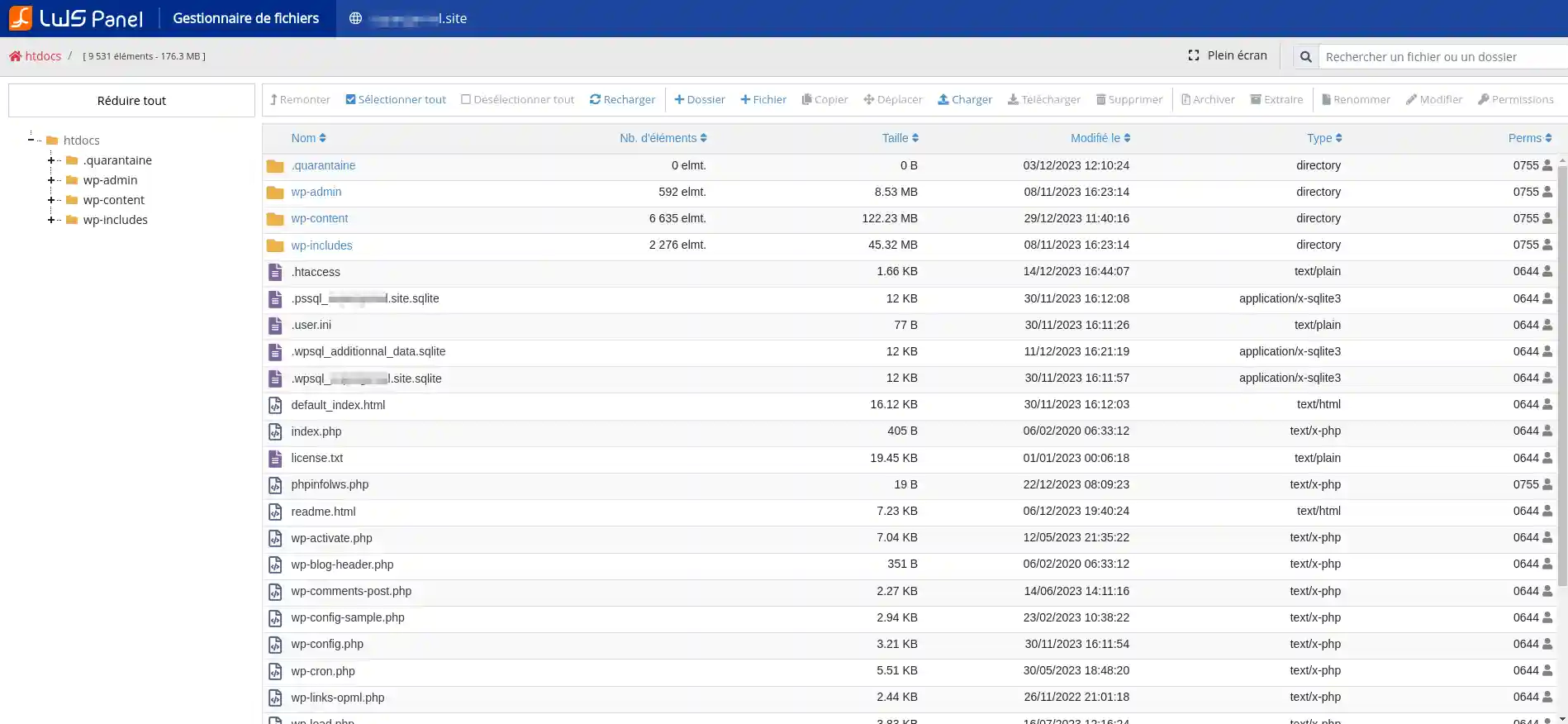
  • if you create a folder called public_html, this may cause your site to malfunction, because in this environment, the expected folder is htdocs.

1. Accessing the file manager

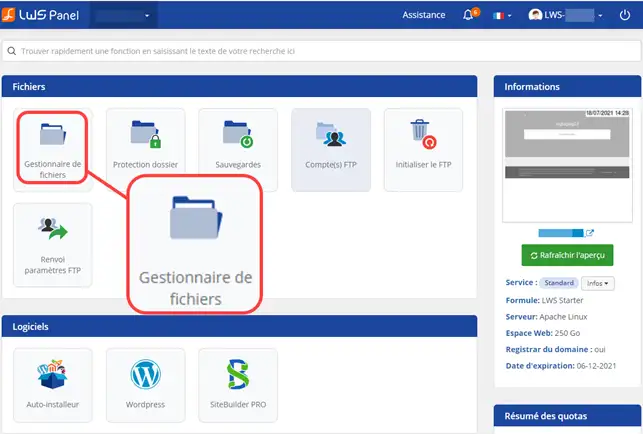
  1. Log in to your LWS account.
  2. Go to the hosting in question from the LWS Panel.
  3. Locate the Files section.
    How do I use the LWS Panel file manager?
  4. Click on the File Manager button.

Expected result

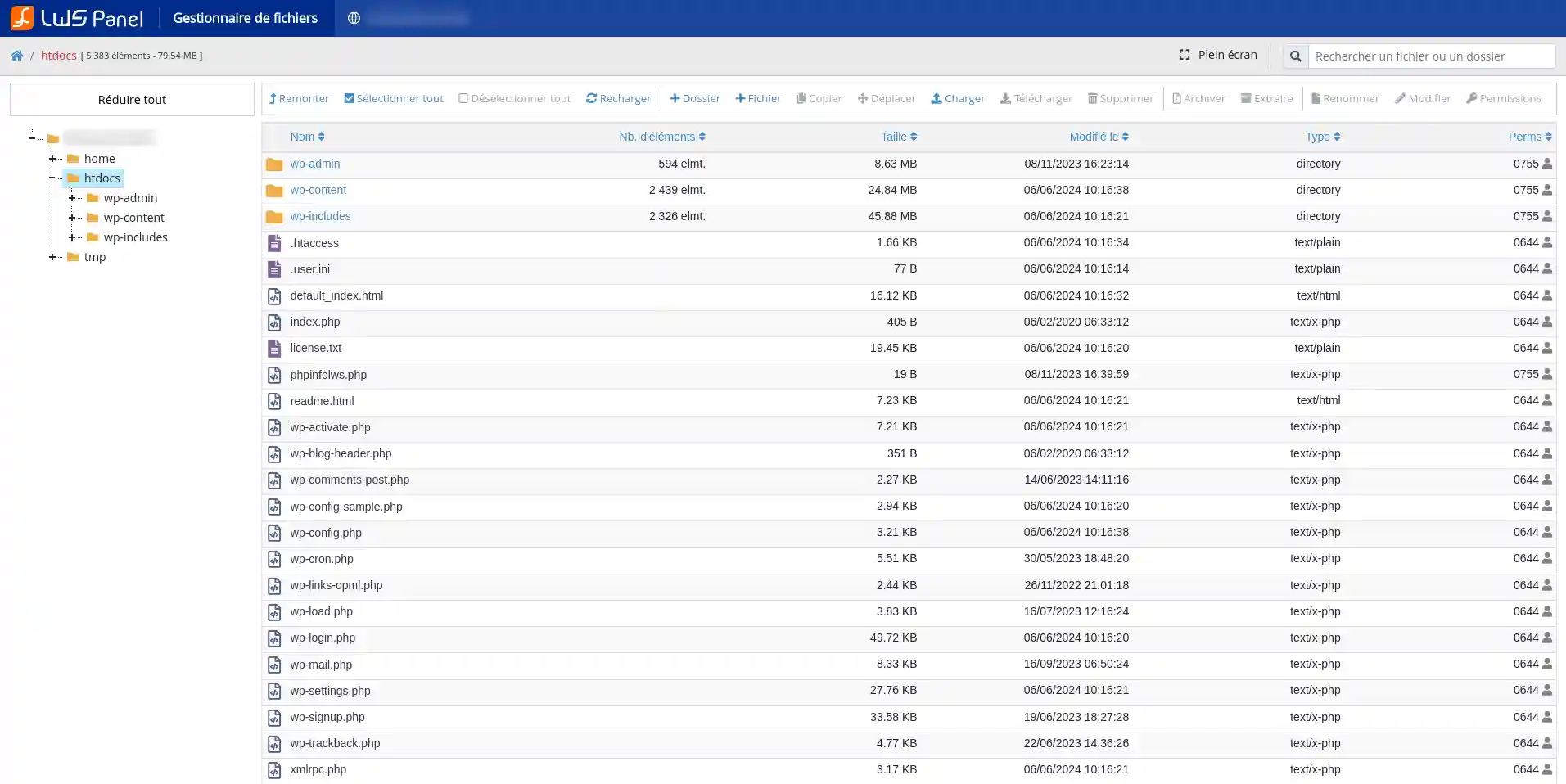
The File Manager opens and displays your folder tree and the contents of the selected folder.

How do I use the LWS Panel file manager?

If the button does not appear

If you don't see the File Manager button :

  • check that you are on the right hosting ;
  • check that your package includes this function;
  • if the tool is not offered, use FTP software such as FileZilla to send and manage your files.

2. Understanding the interface

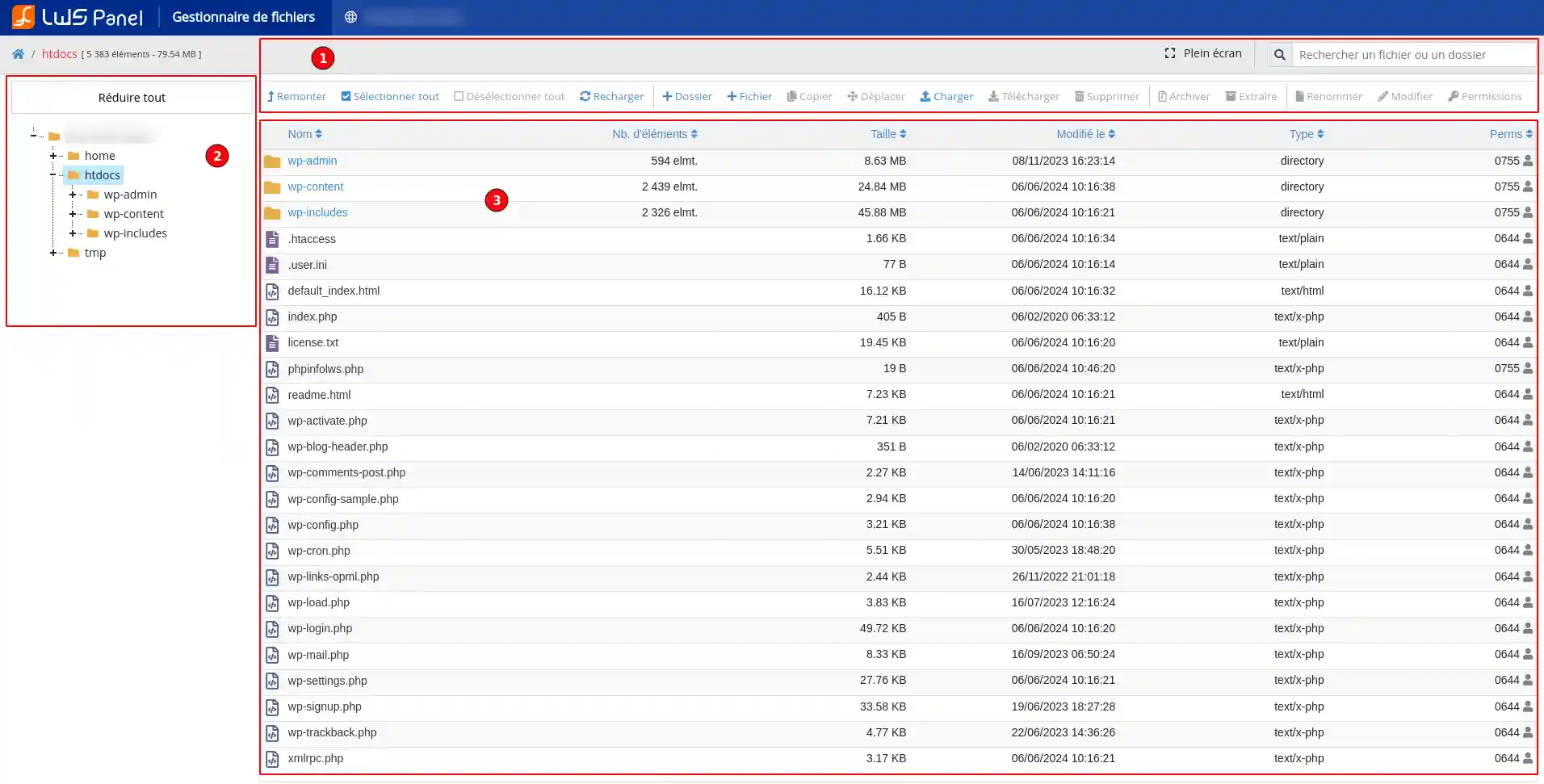
Once you've opened the tool, you'll generally see three main areas:

How do I use the LWS Panel file manager?

1. The action bar at the top

This contains the main buttons you need to act on your files, for example :

  • create a file ;
  • create a folder ;
  • send a file ;
  • delete ;
  • search ;
  • go up one level ;
  • return to home page.

2. The list of folders on the left

This area allows you to navigate through the different folders in your accommodation.

3. The main panel on the right

This displays the contents of the currently selected folder, with useful information such as :

  • name ;
  • type ;
  • size ;
  • date modified ;
  • access rights.

3. Navigating your folders

To move around the file manager :

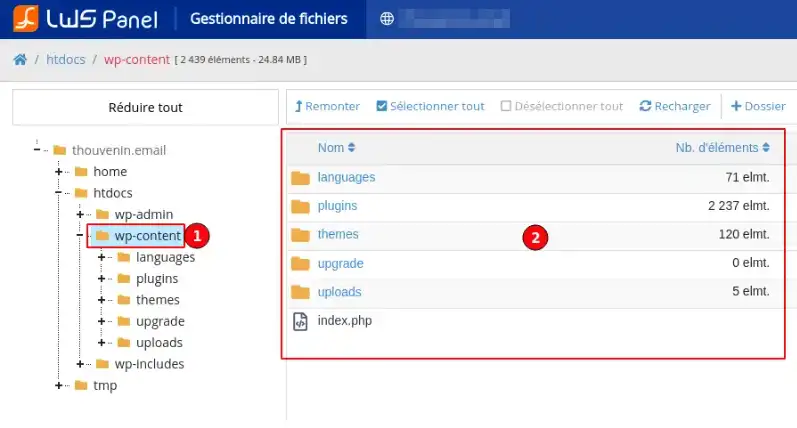
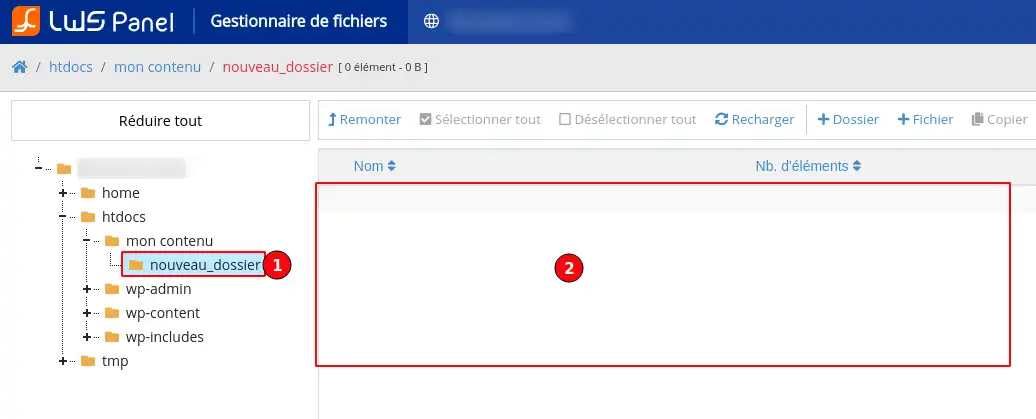
  1. Click on a folder in the left-hand column to open it. (1)
    How do I use the LWS Panel file manager?
  2. Its contents are displayed in the main area. (2)
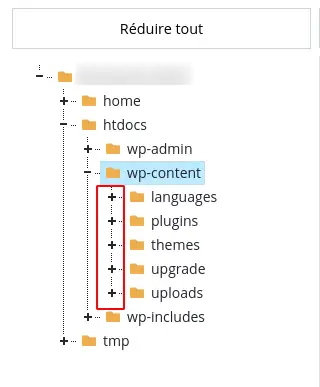
  3. Use the small "+" next to the folders to show or hide their subfolders.
    How do I use the LWS Panel file manager?
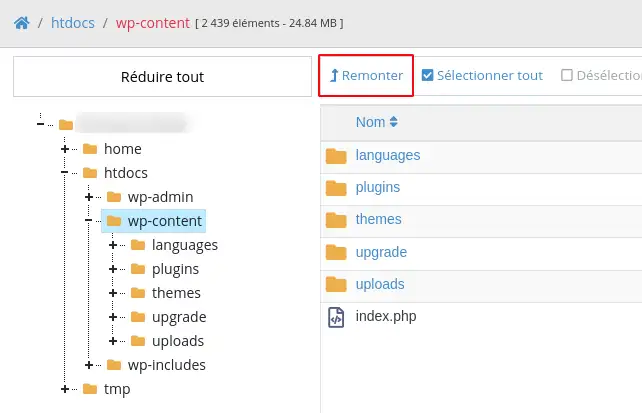
  4. Use the Back button to return to the top level.
    How do I use the LWS Panel file manager?
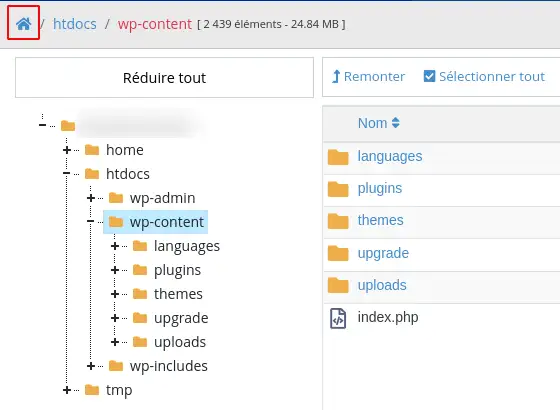
  5. Use the Home icon (2) to return to the main folder.
    How do I use the LWS Panel file manager?
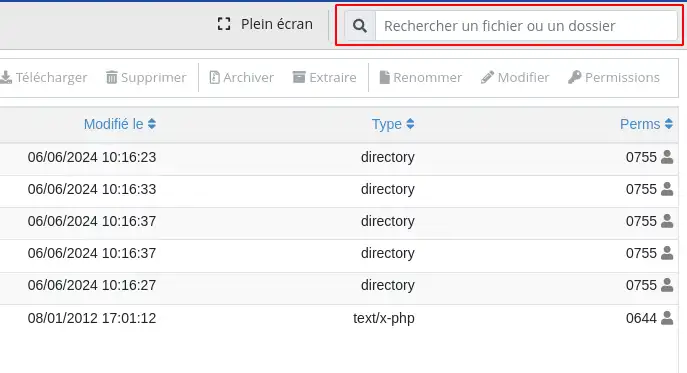
  6. Use the search box if you want to quickly find a file or folder by name.
    How do I use the LWS Panel file manager?
  7. Use the arrows next to each column name to sort the data in ascending or descending order.
    How do I use the LWS Panel file manager?

Tip for beginners

Before creating, sending or modifying a file, always check that you are in the right folder.
If you are working on your website, you will usually be in htdocs.

4. Creating a new file

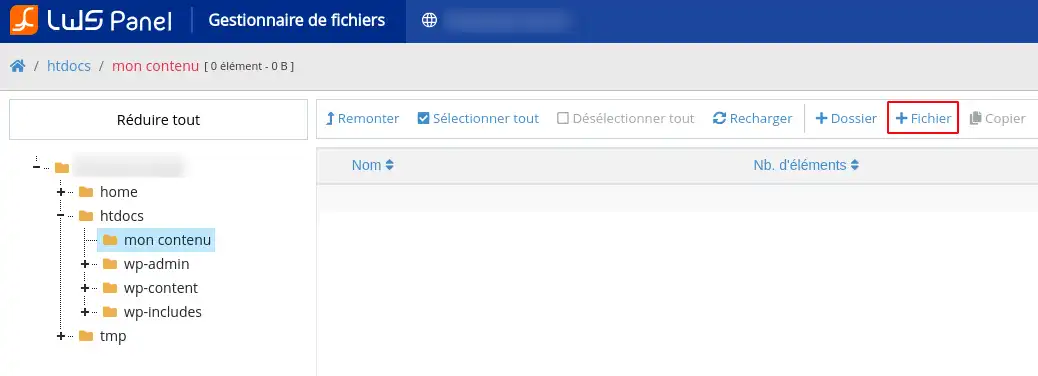
  1. Open the folder in which you want to create the file.
    How do I use the LWS Panel file manager?
  2. Click on the +File button.
    How do I use the LWS Panel file manager?
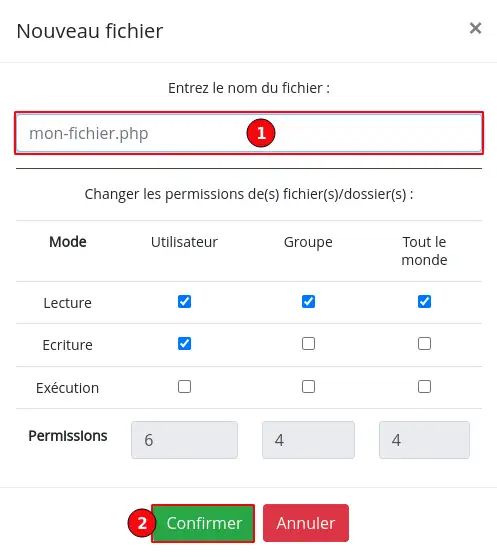
  3. A window opens.
  4. Enter the file name (1).
    How do I use the LWS Panel file manager?
  5. Add the end of the file name, for example :
    .txt for a text file ;
    .html for a web page ;
    .php for a PHP file.
  6. If you don't know what to enter in the permissions, see part 17 or leave the default value.
  7. Click Confirm (2).

Expected result

The new file will now appear in the main panel of the selected folder.

5. Creating a new folder

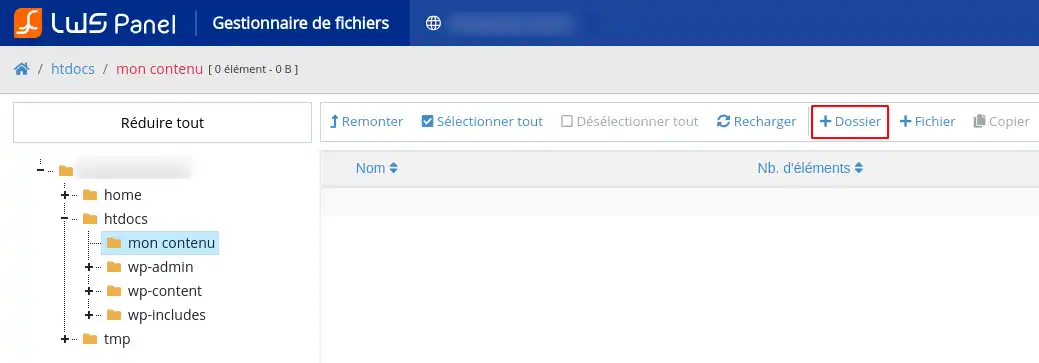
  1. Open the location where you want to create the folder.
    How do I use the LWS Panel file manager?
  2. Click the +Folder button.
    How do I use the LWS Panel file manager?
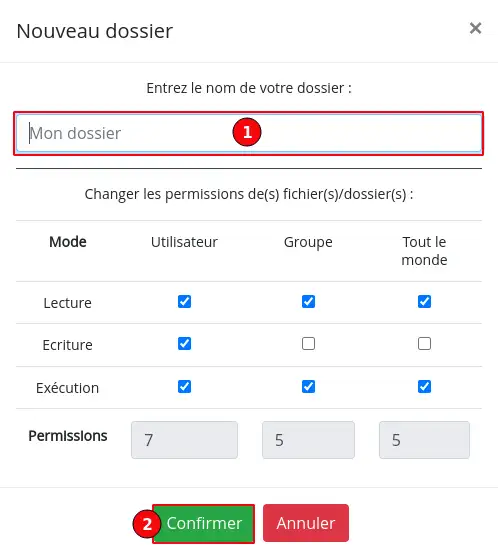
  3. A window will open.
    How do I use the LWS Panel file manager?
  4. Enter the name of the folder (1).
  5. If you don't know what to enter in the permissions, see part 17 or leave the default value.
  6. Click on Confirm. (2)

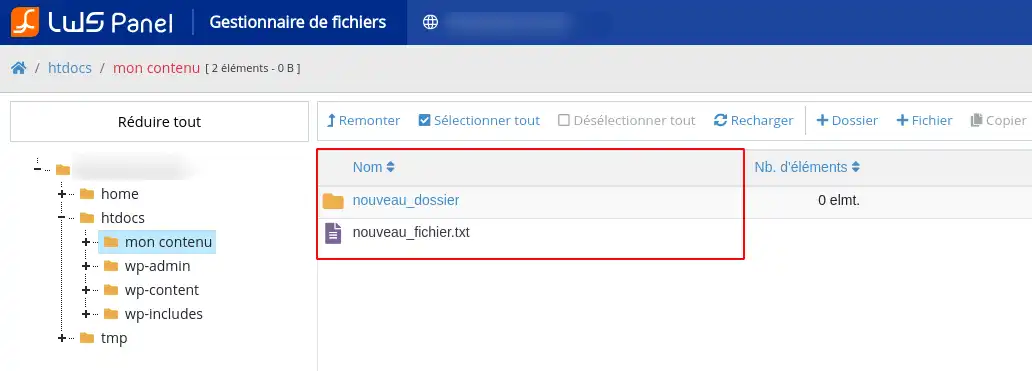
Expected result

The new folder appears immediately in the list of the current folder.

How do I use the LWS Panel file manager?

Check

  • make sure that the folder appears;
  • click on it to check that it opens correctly.

How do I use the LWS Panel file manager?

6. Sending a file from your computer to hosting

The file manager also lets you send a file from your computer to your hosting.

This function is particularly useful for :

  • publishing files on your site ;
  • sending an image ;
  • adding a document;
  • transferring a backup file or archive.

Procedure

  1. Open the folder to which you want to send the file (1)
    How do I use the LWS Panel file manager?
  2. Check that you are in the right location before sending.
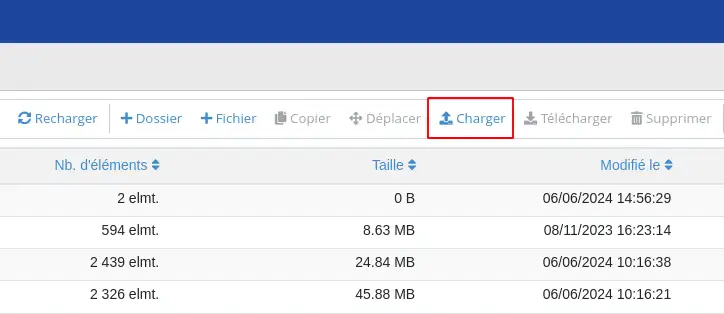
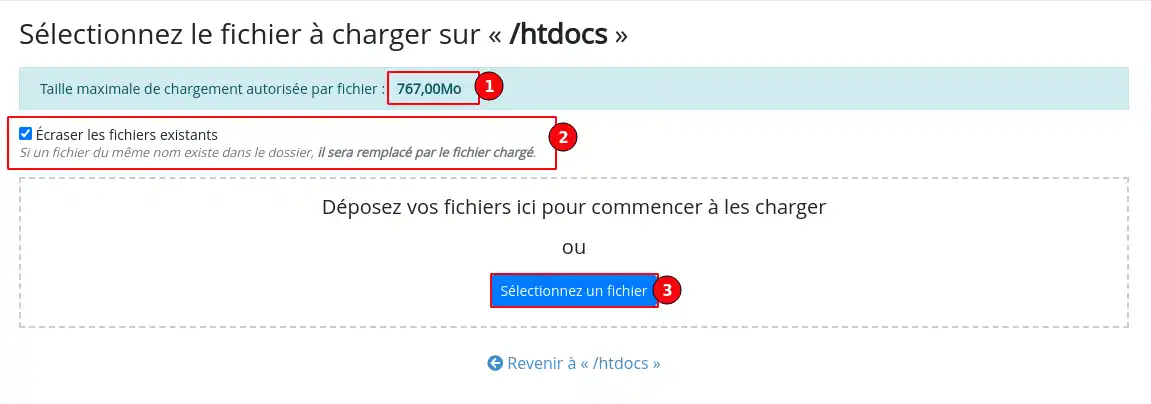
  3. Click on the"Upload" button.
    How do I use the LWS Panel file manager?
  4. Click on the"Select a file" button
    How do I use the LWS Panel file manager?
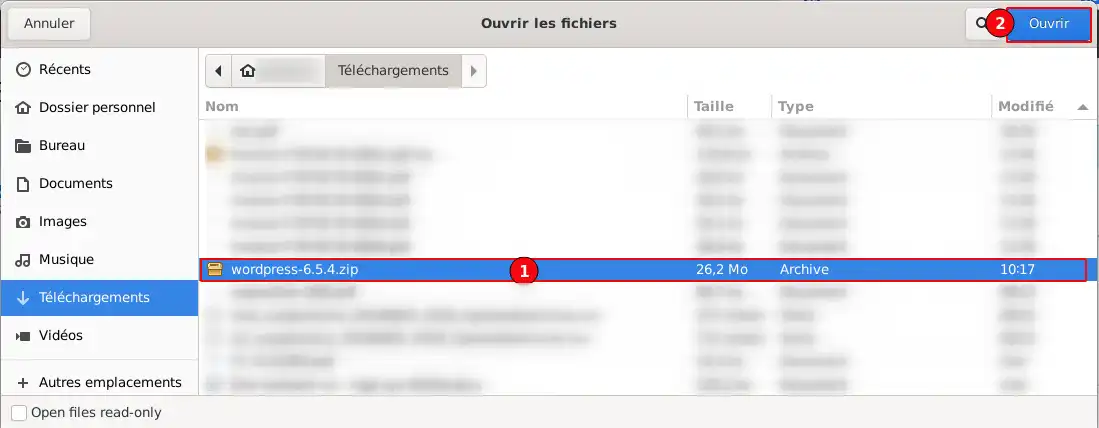
  5. A window will open allowing you to browse the files on your computer.
    How do I use the LWS Panel file manager?
  6. Select the file you want to send. (1)
  7. Confirm your choice. (2)
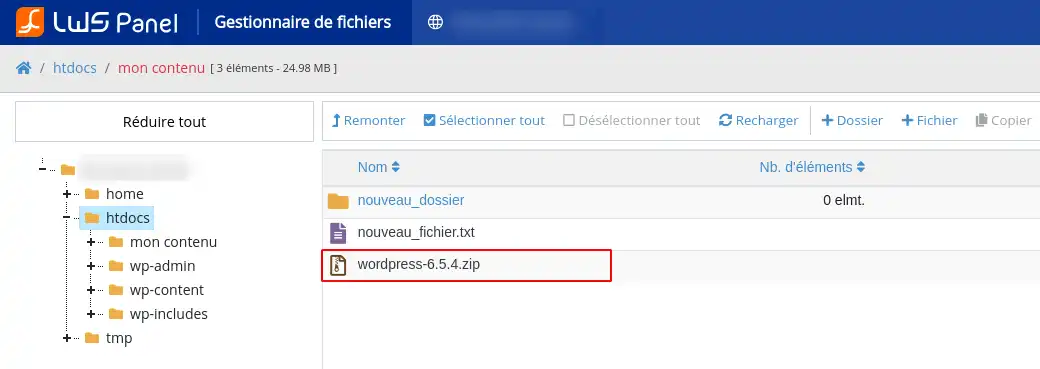
  8. Wait while the file is transferred.

Important note

If the file is to be used on your website, it must be sent to htdocs or one of its sub-folders.

You will not be able to upload files larger than the size indicated(1). In all cases, files larger than 500 MB will be regularly deleted in accordance with our General Terms and Conditions. Their presence on your hosting can therefore only be temporary.

Expected result

The file appears in the chosen folder once the transfer has been completed.

How do I use the LWS Panel file manager?

Check

After uploading :

  • check that the file appears in the folder ;
  • check that the name is correct;
  • if it is a website file, test the display of the page or resource concerned.

7. Download a file to your computer

You can use the file manager to download a file from the hosting site to your computer.

This function can be useful for :

  • keep a backup ;
  • modifying a local file
  • retrieving a document hosted on your space.

Procedure

  1. Open the folder containing the file you wish to recover.
    How do I use the LWS Panel file manager?
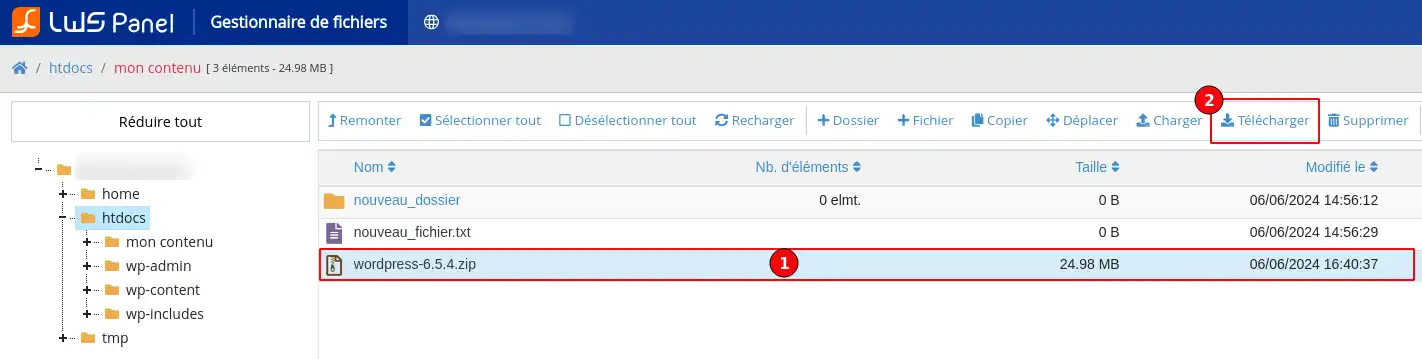
  2. Locate the file concerned.
  3. Select it (1)
    How do I use the LWS Panel file manager?
  4. Click on the Download button. (2)
  5. Depending on your browser, a window may open asking you where to save the file.
  6. Choose the location on your computer.
  7. Confirm the saving.

Expected result

The file is downloaded from your hosting to your computer.

Check

After downloading :

  • open the destination folder on your computer;
  • check that the file is present;
  • if necessary, open it to check that it is the right file.

8. Renaming a file or folder

You can rename a file or folder directly from the File Manager.

This is useful, for example, if you want to:

  • correct an error in a name ;
  • replace a temporary name with a permanent name;
  • organise your files better;
  • adapt the name of a file to its purpose.

Procedure

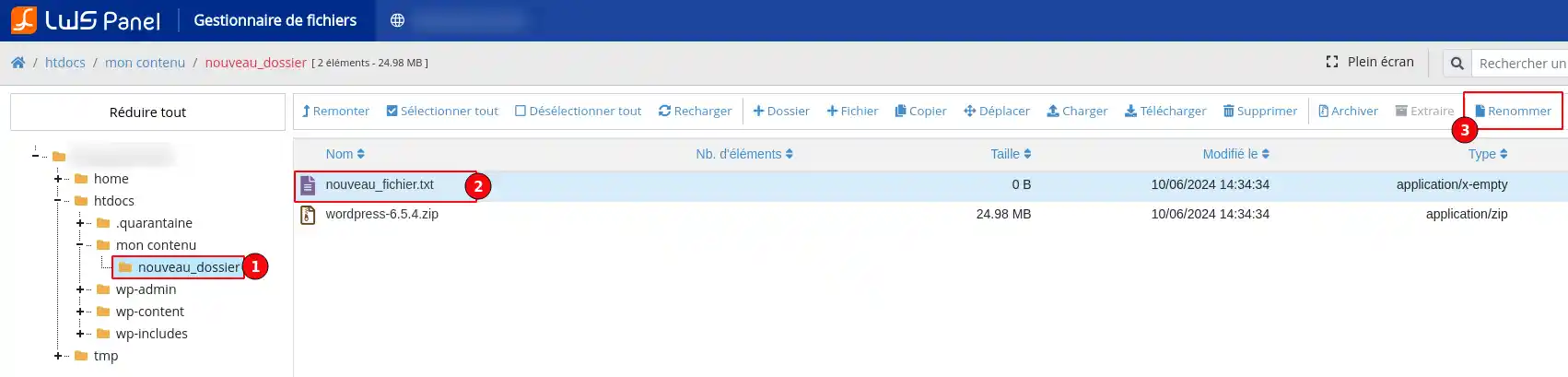
  1. Open the folder containing the file or folder you wish to rename. (1)
    How do I use the LWS Panel file manager?
  2. Locate the item concerned in the list.
  3. Select the file or folder. (2)
  4. Click the Rename button. (3)
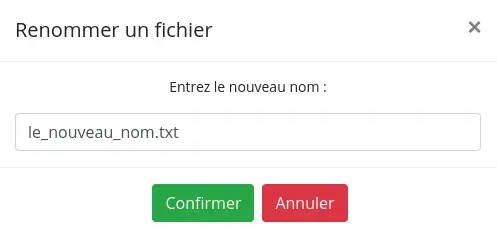
  5. An edit window opens.
    How do I use the LWS Panel file manager?
  6. Enter the new name.
  7. Check the name carefully before confirming.
  8. Click on the confirmation button.

Important note

If you rename a website file, do not change the end of the name by mistake.

For example :

  • index.html must remain an .html file ;
  • config.php must remain a .php file.

The end of the file name, also called the extension, indicates its type.
If you change it unintentionally, the file may no longer function correctly.

Expected result

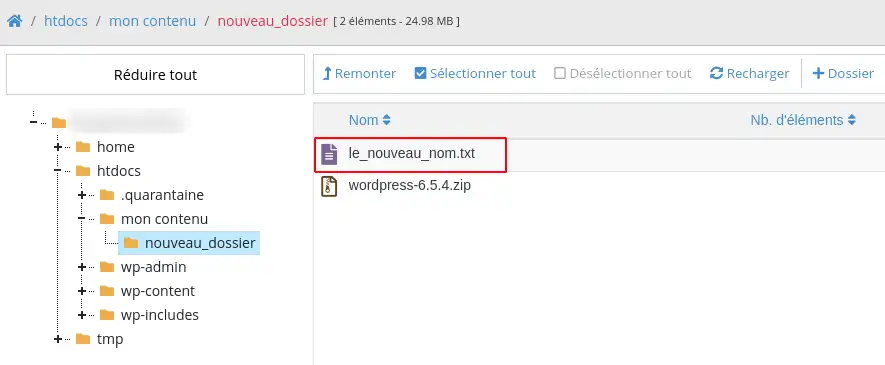
The file or folder appears immediately with its new name in the list.

How do I use the LWS Panel file manager?

Check

After renaming :

  • check that the new name is displayed ;
  • check that the item is still in the correct folder;
  • if you have renamed a file used by your site, then test the page concerned to make sure that everything is still working correctly.

9. Deleting a file or folder

The File Manager can also be used to delete a file or folder that is no longer required.

Before deleting an item

Before confirming a deletion, make sure that the item is no longer required.

For example, don't delete a file if you don't know what it's for.
Some files are essential for the proper functioning of your site or certain applications installed on the hosting.

If in doubt :

  • download a backup copy ;
  • or temporarily rename the file instead of deleting it straight away.

Procedure

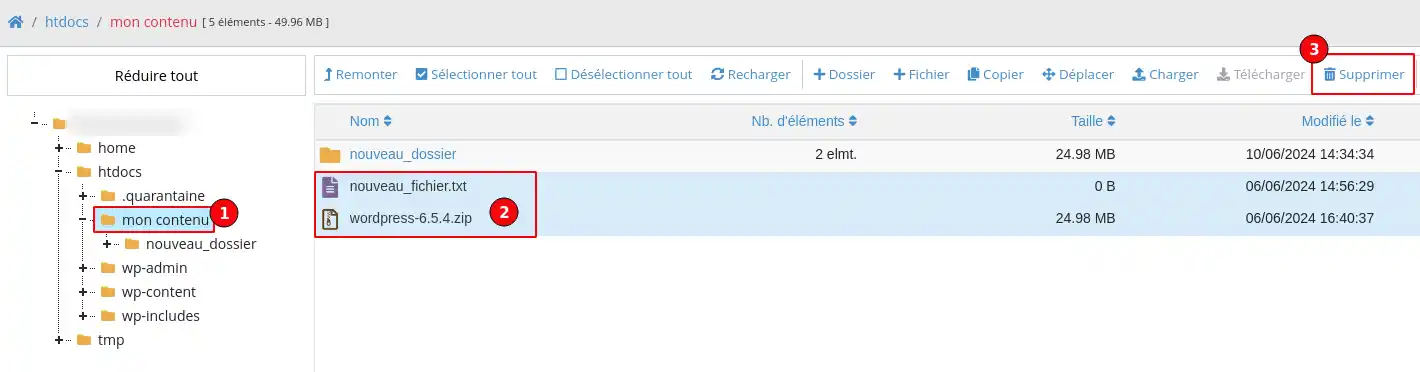
  1. Open the folder containing the file or folder to be deleted. (1)
    How do I use the LWS Panel file manager?
  2. Locate the item in question.
  3. Select it (2)
  4. Click on the Delete button. (3)
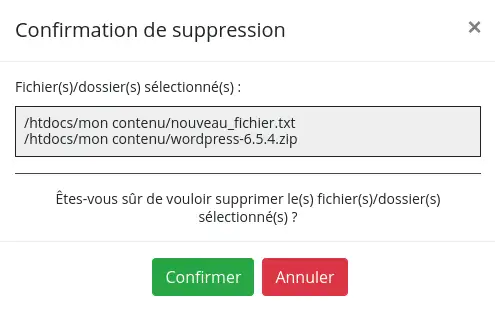
  5. A confirmation prompt is displayed
    How do I use the LWS Panel file manager?
  6. Read the message carefully.
  7. Confirm the deletion only if you are sure of your choice.

Expected result

The file or folder no longer appears in the list of the current folder.

Check

After deletion :

  • check that the item no longer appears in the folder ;
  • if you have deleted a file linked to your site, then open your site to check that there are no errors on any important pages.

10. Copying a file or folder

The copy function allows you to create a duplicate file or folder without deleting the original.

This function is useful if you want to :

  • keep a backup version ;
  • duplicate an existing structure
  • create a similar file and then modify it.

Procedure

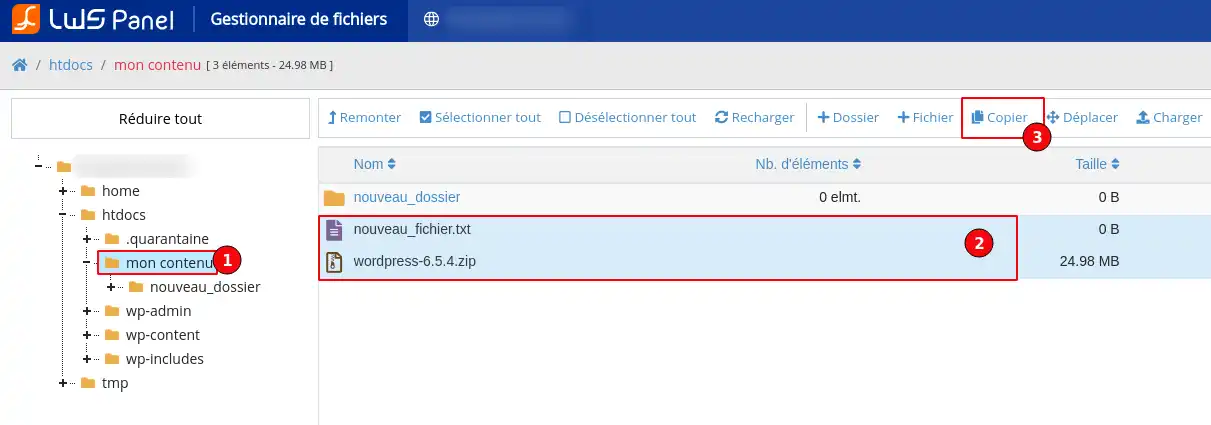
  1. Open the folder containing the file or folder you wish to copy (1)
    How do I use the LWS Panel file manager?
  2. Select the item concerned. (2)
  3. Click the Copy button (3)
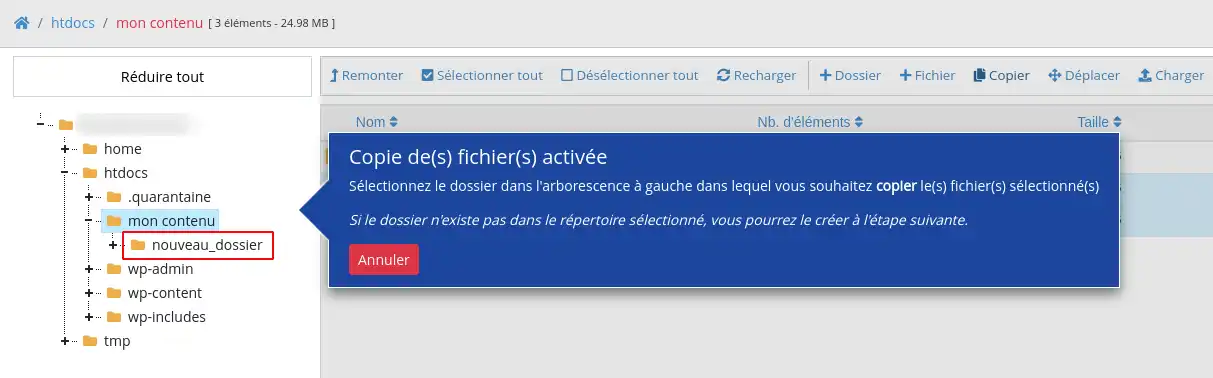
  4. Choose the destination folder.
    How do I use the LWS Panel file manager?
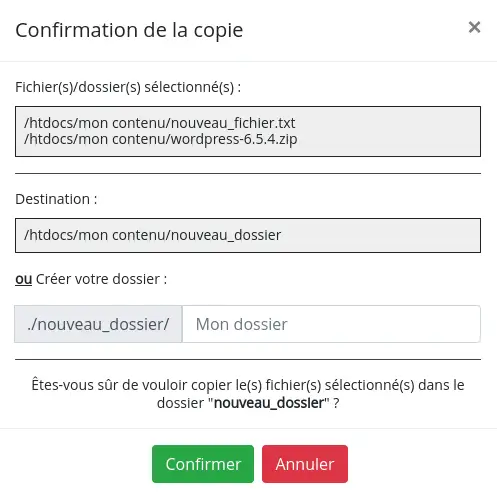
  5. Check the location you have chosen.
    How do I use the LWS Panel file manager?
  6. Confirm the operation.

Expected result

A copy of the item appears in the destination folder.

Check

After copying :

  • check that the original item is still present ;
  • check that a second item has been created in the target folder;
  • open the destination folder to confirm that the copy is present.

11. Moving a file or folder

The move function lets you change the location of a file or folder.

It is useful for :

  • better organise your files ;
  • move a file to the correct folder
  • correct a location error.

Procedure

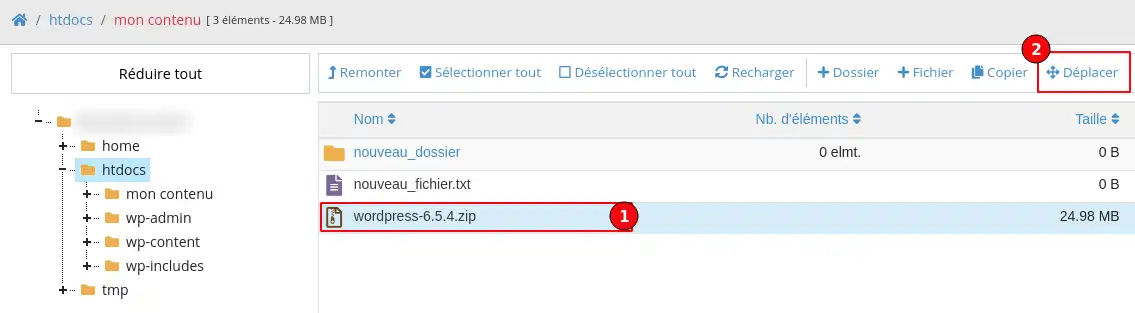
  1. Open the folder containing the item you want to move.
    How do I use the LWS Panel file manager?
  2. Select the file or folder concerned. (1)
    How do I use the LWS Panel file manager?
  3. Click the Move button. (2)
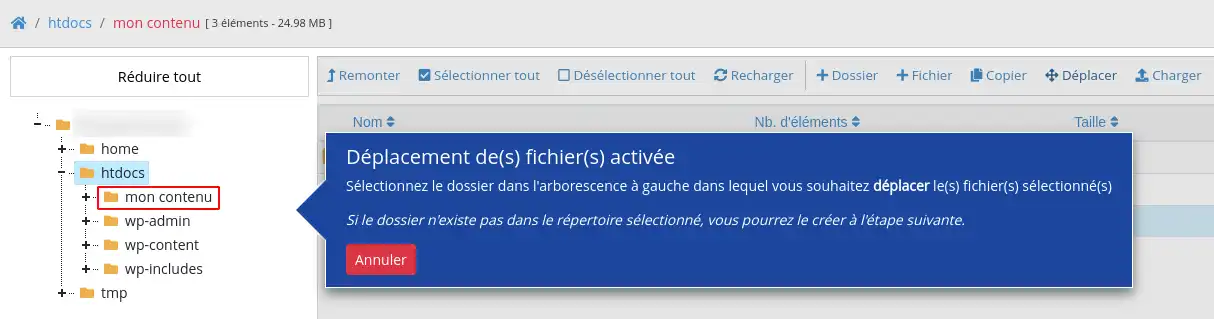
  4. Choose the new destination folder.
    How do I use the LWS Panel file manager?
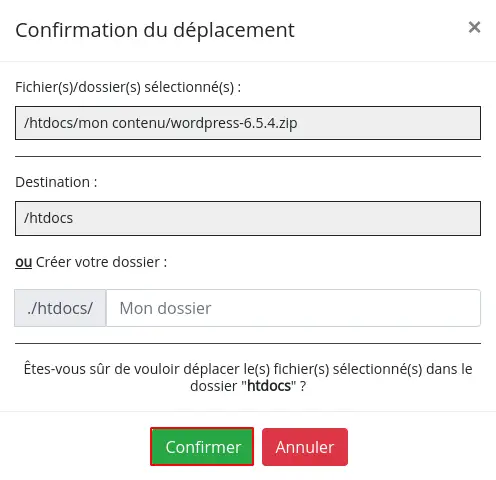
  5. Check the selected folder carefully.
    How do I use the LWS Panel file manager?
  6. Confirm the move.

Important note

If you are moving files to be displayed on your site, make sure you place them in htdocs or one of its sub-folders.

If you move these files to home or tmp, they will no longer be accessible from the web.

Expected result

The item no longer appears in its original folder and appears in the destination folder.

Check

After moving :

  • open the original folder to check that the item no longer appears there;
  • open the destination folder to check that it is still there;
  • if the file concerned your site, then test its display.

12. Modifying a file directly online

The file manager lets you modify certain files directly from your browser, without using any external software.

This function is useful for :

  • quickly correct a text file ;
  • edit an HTML page
  • adjusting a PHP file
  • make a small correction to a CSS or TXT file.

Before modifying a file

Before making any changes, it is advisable to keep a copy of the file, especially if it is important for your site.

You can, for example

  • download the file to your computer ;
  • or create a copy before modifying it, if possible.

Procedure

  1. Open the folder containing the file to be modified.
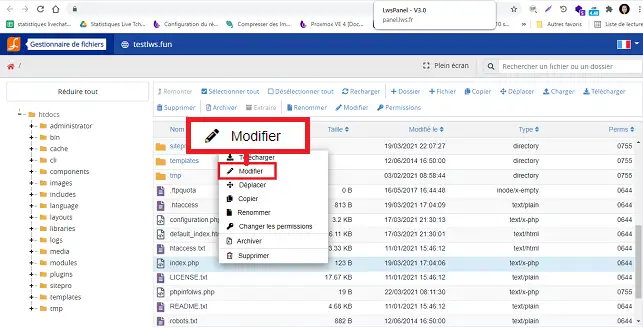
  2. Select the file concerned.
    How do I use the LWS Panel file manager?
  3. Click on the edit button in the menu or right-click on the file.
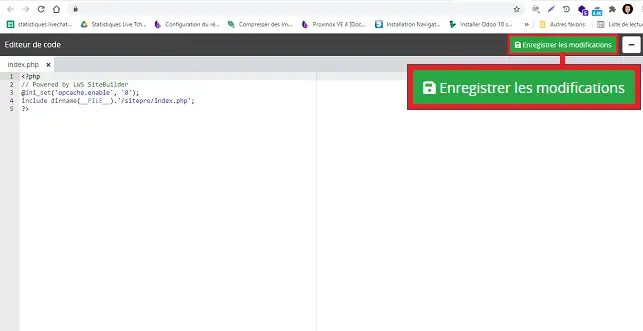
  4. The built-in editor opens.
    How do I use the LWS Panel file manager?
  5. Make the necessary changes.
  6. Review the content carefully before saving.
  7. Click the "Save changes" button.

Expected result

The changes are saved in the file.

Check

After the changes have been made :

  • re-open the file to check that the changes have been taken into account;
  • if this file has an impact on your site, refresh the relevant page in your browser to check the result.

[bcolor_orange] If you are using a cache system, remember to purge it so that you can view your changes[/bcolor].

13. Compressing files or folders

Compression allows you to combine several files or folders into a single archive, usually in ZIP format.

This function can be useful for :

  • preparing a backup ;
  • grouping several files together
  • making downloading or storage easier.

Procedure

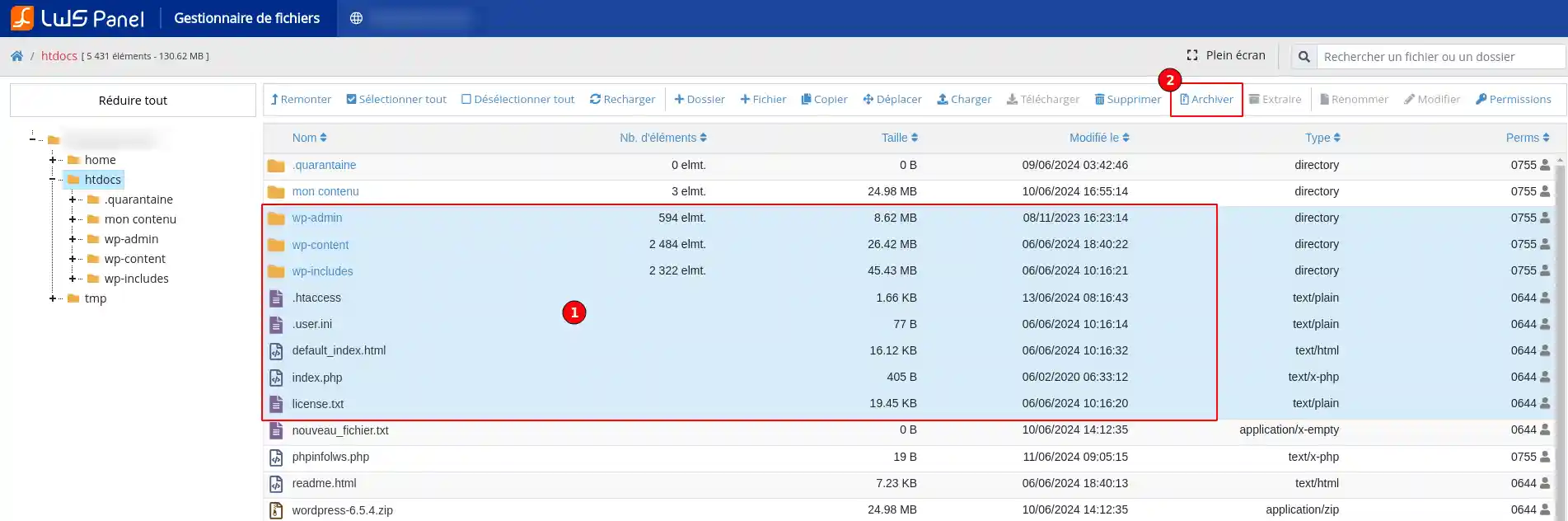
  1. Open the folder containing the files or folders to be compressed.
  2. Select the item(s) concerned. (1)
    How do I use the LWS Panel file manager?
  3. Click on the"Archive" button (2)
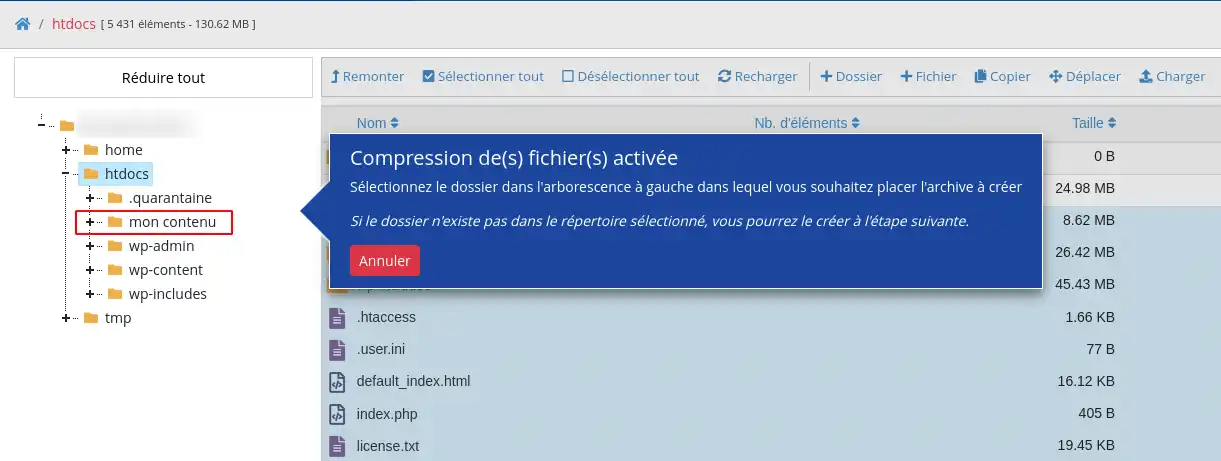
  4. Choose the destination folder for the archive
    How do I use the LWS Panel file manager?
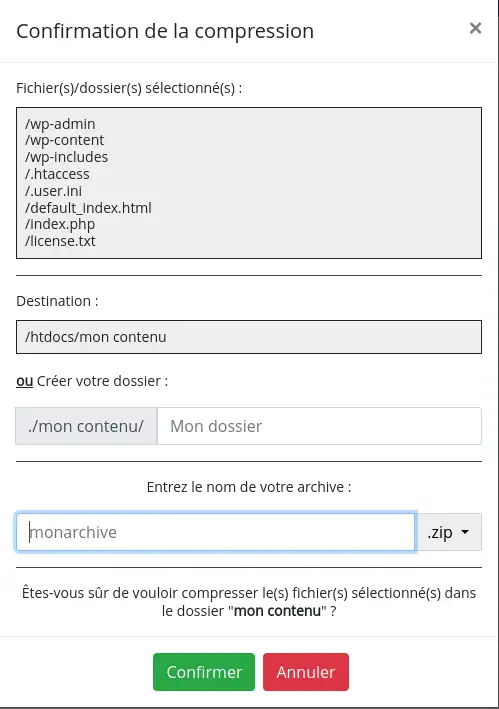
  5. Choose the archive name.
    How do I use the LWS Panel file manager?
  6. Confirm the operation.

Expected result

A compressed archive appears in the current folder.

How do I use the LWS Panel file manager?

Check

After compression :

  • check that a new archive file is present;
  • check that its name corresponds to what you are expecting;
  • keep this archive as a backup if necessary.

14. Uncompressing an archive

Decompression allows you to extract the contents of an archive directly from the hosting.

This function is useful if you have sent a ZIP file containing several site or job files.

Procedure

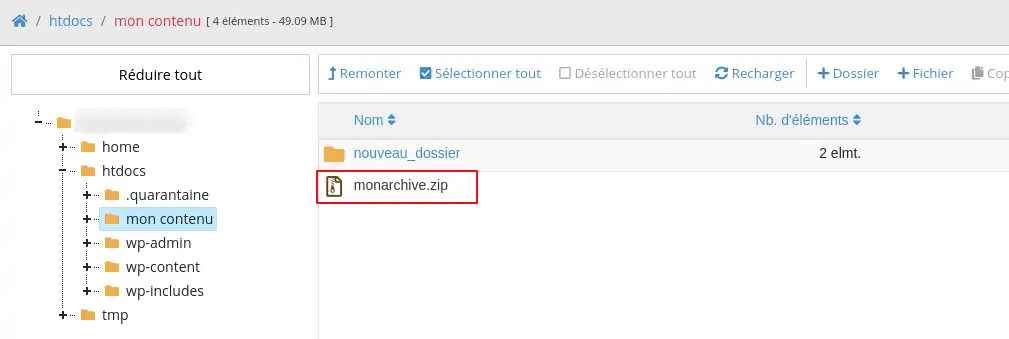
  1. Open the folder containing the archive to be extracted.
  2. Locate the archive file concerned.
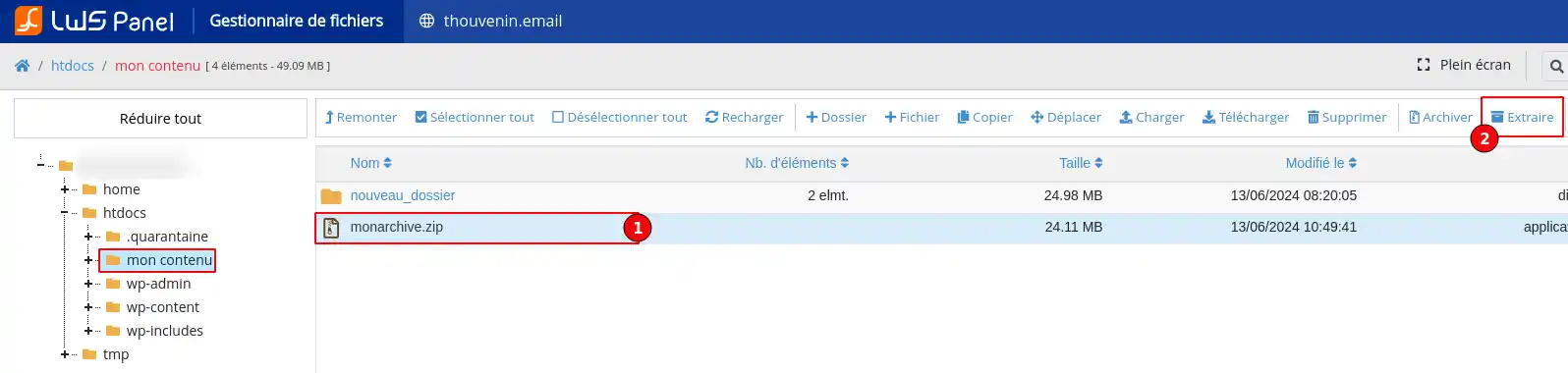
  3. Select it (1)
    How do I use the LWS Panel file manager?
  4. Click the Extract button. (2)
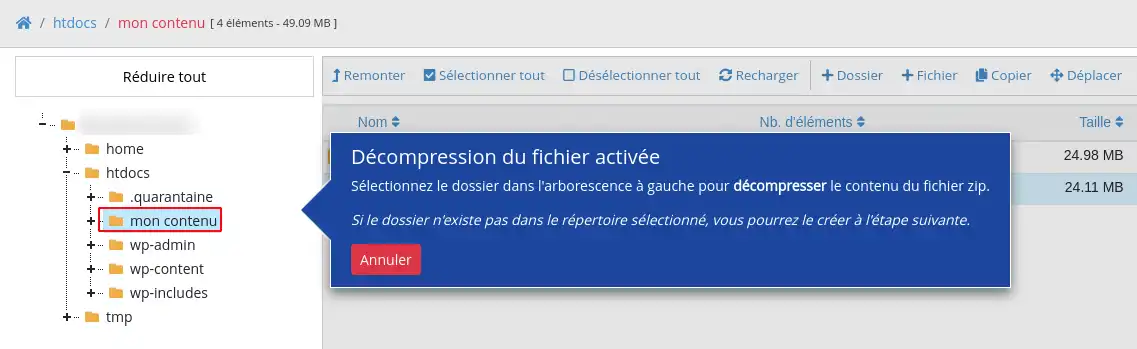
  5. Choose the destination folder if this option is available.
    How do I use the LWS Panel file manager?
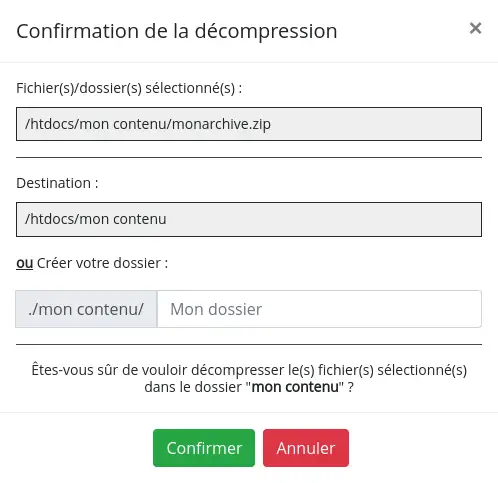
  6. Confirm the extraction.
    How do I use the LWS Panel file manager?

Important note

Before extracting an archive, check that you are in the right folder.
If the archive contains files from your site, extraction should generally be performed in htdocs or in the relevant sub-folder.(aide.lws.fr)

Expected result

The files contained in the archive appear in the chosen folder.

How do I use the LWS Panel file manager?

Check

After decompression :

  • check that the extracted files are present;
  • open the folder created if the archive generated a new directory;
  • if the files relate to your site, test its display afterwards.

15. Viewing or changing access rights for a file or folder

The File Manager also lets you view the access rights, also known as permissions, of a file or folder.

Access rights define the authorisations applied to the item, for example whether it can be read, modified or executed.

Important

This function is more technical than the others.
If you're just starting out and don't know exactly what value to use, it's best not to modify permissions unnecessarily.

Incorrect configuration can prevent your site from working properly or block access to certain files.

General procedure

  1. Open the folder containing the file or folder in question.
  2. Select the desired item.
    How do I use the LWS Panel file manager?
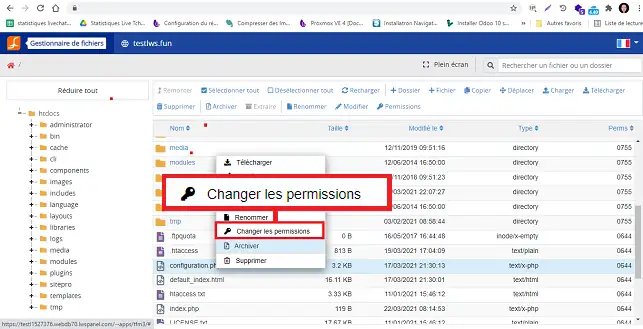
  3. Click on the Permissions button in the menu or right-click with the mouse on the file or folder.
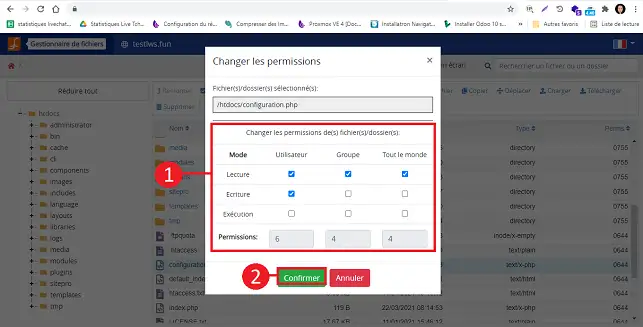
  4. Check the proposed values.
    How do I use the LWS Panel file manager?
  5. Only change them if you know exactly what you need to do.
  6. Confirm the operation.

Expected result

The new access rights are saved on the item concerned.

Check

After modification :

  • check that the element remains accessible;
  • if the element is used by your site, then test the page or function concerned;
  • if there is a problem, restore the previous configuration if you know it.

Normally, the default rights for a folder are "755" and for a file "644"
.

[bcolor_orange]If you are unfamiliar with managing rights to files on a hosting system, we recommend that you ask someone with the necessary knowledge to accompany you to avoid any problems with the operation of your site or application. bcolor]

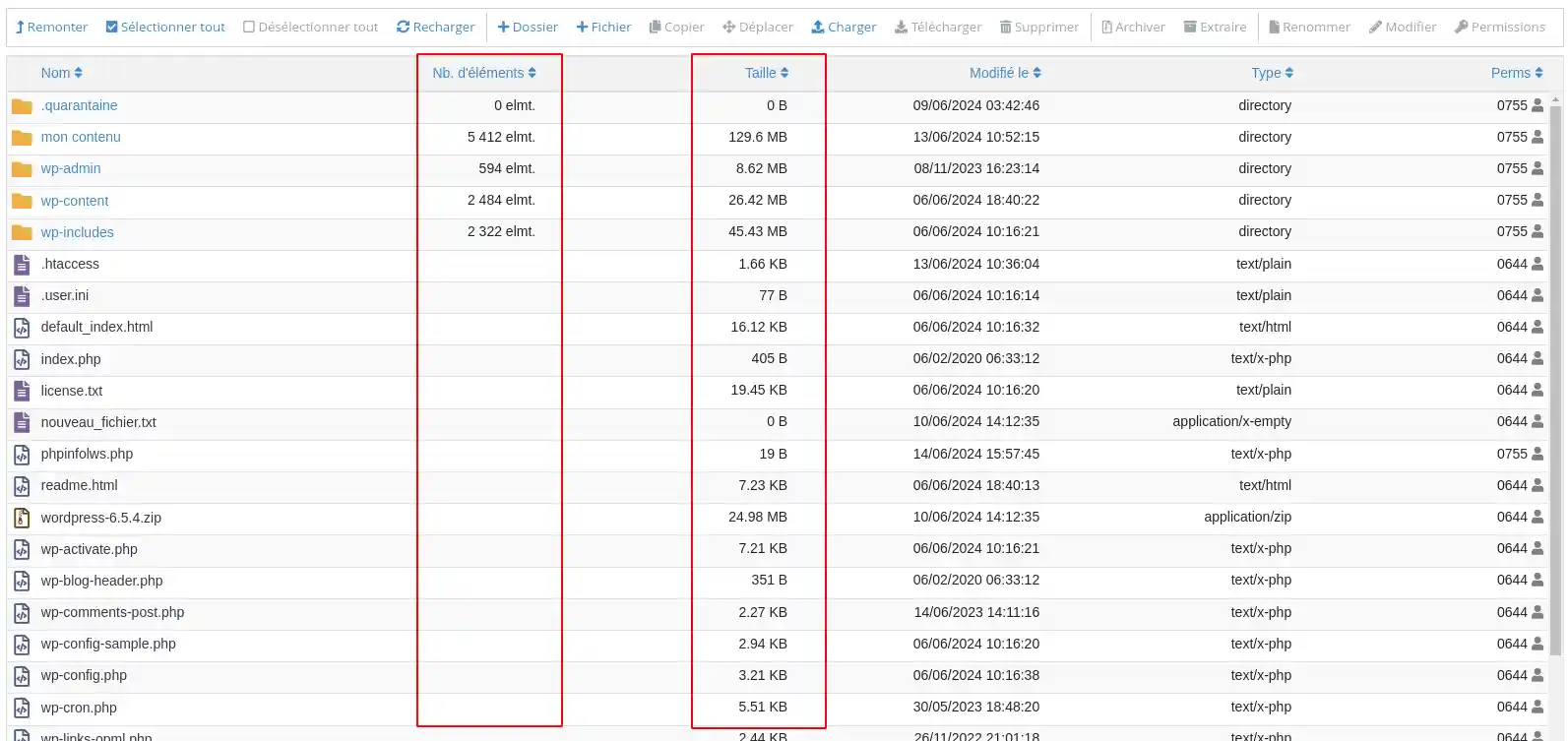
16. View the size of files and folders

You can also use the file manager to view various information about the items on your hosting.

In particular, you can view :

  • the names of files and folders ;
  • the number of items contained in a folder ;
  • the size of files and folders ;
  • date modified ;
  • type ;
  • permissions.

Procedure

  1. Access the File Manager.
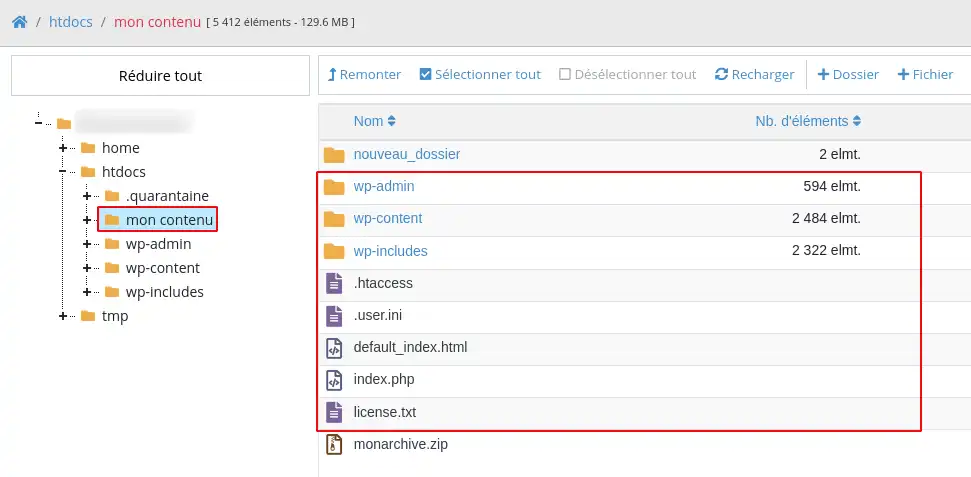
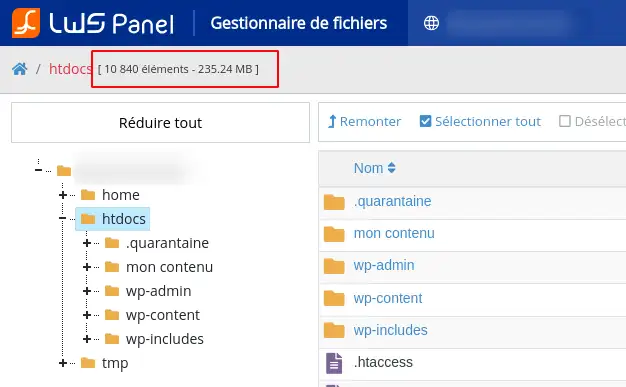
  2. Open the folder whose contents you wish to view. You will see a summary of the number of items and the size of the selected folder.
    How do I use the LWS Panel file manager?
  3. Look at the main panel on the right of the interface.
  4. Locate the line corresponding to the file or folder you are interested in.
    How do I use the LWS Panel file manager?
  5. Look at the various columns to see what information is available, including:
  • number of items;
  • size;

Common problems and solutions

The "File Manager" button does not appear

Possible cause

Your package does not offer this tool (domain package), or you are not on the right service in your customer area.

Solution

I've sent my files, but my site isn't displayed correctly

Probable cause

The files have not been placed in the right folder.

Solution

Make sure that the site files have been uploaded to htdocs.
The home and tmp folders are not used to publish site content directly.

My site displays a "Forbidden" error

Probable cause

An incorrect folder structure has been used, for example creating a public_html folder instead of using the htdocs folder.

Solution

  • do not create a public_html folder if your hosting expects htdocs;
  • place the site files directly in htdocs;
  • re-test the display of the site after correction.

A security message is displayed when the manager is opened

Probable cause

The domain used to access the manager does not yet have a valid SSL certificate.

Solution

You can :

  • accept the security exception if you are sure you are using the correct access link ;
  • or install an SSL certificate to remove this warning in the future.

I don't know what to do with the home folder

Explanation

The Home folder may be used by certain projects or tools such as the Moodle CMS, but it does not correspond to the main web publishing folder.
To display a website, use htdocs.

I've modified a file and my site no longer works

Probable cause

An error may have been introduced into the file during editing.

Solution

Conclusion

You now know how to use the LWS Panel file manager.

When in doubt, remember these two points in particular:

  • always work in the right folder;
  • for a website, files should be placed in htdocs so that they can be accessed from your domain name.

Rate this article :

3.5/5 | 4 opinion

This article was useful to you ?

Article utileYes

Article non utileNo

MerciMerci ! N'hésitez pas à poser des questions sur nos documentations si vous souhaitez plus d'informations et nous aider à les améliorer.


Vous avez noté 0 étoile(s)

Similar articles


Questions sur l'article
Kodesh Il y a 1265 days
Bonjour j'ai un problème avec l'hébergement de mon site, dans ma rubrique fichier le gestionnaire de fichiers n'apparait pas, comment faire ? par ce que je dois pusher mon site. SVP urgence
See the
1 answers
fabrice-LWS - Il y a 1264 days
Bonsoir, vous avez la possibilité de publier votre site en utilisant un logiciel tel que FileZilla. Pour cela, vous pouvez vous aider de la procédure suivante: https://aide.lws.fr/a/79 . Si vous disposez d'une formule Domaine, l'accès au gestionnaire de fichiers n'est pas possible. Il vous faudra dans ce cas, utiliser FileZilla.
Utile ?
cdramb78 Il y a 747 days
dans l'arborescence il y a un dossier Home ? A quoi sert-il ?
See the
1 answers
Jordan-LWS - Il y a 743 days

Bonjour,


Je vous remercie pour votre message.

Nous avons ajouté récemment l'accès à ce répertoire, car il est possible que pour l'installation de certains projets, il soit nécessaire et certains fichiers correspondant à des CMS, ERP ou autre peuvent également se loger dedans.

Étant donné que ce répertoire est compatibilité dans votre quota disque, nous l'avons tout naturellement rajouté au gestionnaire de fichier. 

Je vous remercie pour votre attention et reste à votre disposition pour toute autre question ou complément d'information.

Cordialement, L'équipe LWS

Utile ?
israel Il y a 294 days
Bonjour. j'ai chargé les fichiers dans le gestionnaire mais lorsque je lance le nom de domaine, j'ai un message forbiden qui s'affiche
See the
1 answers
Maxence-LWS - Il y a 292 days

Bonjour,

Je constate que vous avez créée un dossier "public_html", il ne faut pas faire cela, mais déposer vos fichiers directement dans "htdocs", c'est l'équivalent de "public_html" je vous rassure.

Nous sommes là pour vous aider et vous accompagner au besoin.

Vous pouvez contacter gratuitement notre support technique pour obtenir de l'aide via cette page : https://www.lws.fr/contact.

Cordialement, L'équipe LWS

Utile ?
annaramata Il y a 93 days
Bonjour, j'essaie de deployer mon projet laravel oriente admin sur un sous-domaine et mon web app oriente user mais si je charge mon projet laravel dans le sous dossier cree pour le sous-domaine cela ne marche pas. Comment regler ce soucis svp?
See the
1 answers
Maxence-LWS - Il y a 93 days

Bonjour,

Ce type de configuration (déploiement de plusieurs projets Laravel sur des sous-domaines, gestion des chemins, du serveur web, des vhosts, etc.) nécessite souvent l’analyse de paramètres serveur et d’informations sensibles (arborescence, configuration de votre formule, .env, permissions, etc.).

Nous vous invitons donc à ouvrir un ticket auprès du support technique via votre PANEL LWS afin que l’équipe puisse :

  • analyser précisément votre configuration,

  • accéder aux informations nécessaires en toute sécurité,

  • vous guider pas à pas ou effectuer les corrections requises.

Rassurez vous ce support est sans frais et inclus.

Vous pouvez créer un ticket directement depuis votre espace client, rubrique Assistance / Support technique.

Je vous remercie de votre attention et reste à votre disposition pour toute autre question ou complément d'information.

Vous pouvez également contacter notre support technique pour obtenir de l'aide. Vous pouvez nous contacter depuis votre espace client ou sur cette page : https://www.lws.fr/contact

Cordialement, L'équipe LWS 

Utile ?
CST44 Il y a 77 days
Bonjour, Y a-t-il un moyen pour conserver le tri dans le gestionnaire de fichiers ? En effet, je travaille fréquemment sur les derniers fichiers modifiés.En cliquant l'entête Modifié le, le tri se fait bien et vite mais il faut le refaire tout le temps
See the
1 answers
Jordan-LWS - Il y a 75 days

Bonjour,

Je vous remercie de votre attention et reste à votre disposition pour toute autre question ou complément d'information.

Cependant, le système de tri est actualisé et mis par défaut à chaque nouvelle utilisation.

Si vous souhaitez un gestionnaire de fichiers ayant la capacité de mémoriser ce genre de filtre, n'hésitez pas à utiliser des gestionnaires de fichiers par le biais du protocole FTP, par exemple.

Cela vous permettra de pouvoir travailler plus "sereinement"

Je vous remercie de votre attention et reste à votre disposition pour toute autre question ou complément d'information.

Cordialement, L'équipe LWS 

Utile ?

Ask the LWS team and its community a question